Women are often disproportionally affected by climate change impacts which aggravate existing gender inequalities and as a result of persisting gender norms and discriminations. Women and men also contribute to climate change responses in different ways.
The current public debate on African migration to Europe is largely fuelled by visions of boats crossing the Mediterranean Sea, filled with desperate people in search of a better life. The narrative positions Africa as a “continent on the move” whose people are surging into Europe on a seemingly endless tide. Although media images of desperate African refugees fleeing to Europe do portray the daily reality and the often-tragic consequences of the treacherous crossing, the framing conceals more than it reveals.
Against a background of political and cultural disruption, Perspectives approached writers to inquire, speculatively or not so speculatively, into an African future. The result is an eclectic mix of contributions and conversations across the arts, culture, philosophy and politics. They offer glimpses of African futures – fantastic, idealistic, or sober, but always self-confident – that place the continent at the centre of a world to come.
The revised, second edition (2018) of “Urban Planning Processes in Lagos” is the result of a yearlong research process that examines the relation between urban policies, urban interventions, the role of governance, and the different actors in Lagos. The publication shows that Lagos urban policies do not often benefit those at the centre of economic development: the Lagosians – of which a significant number lives below the poverty line.
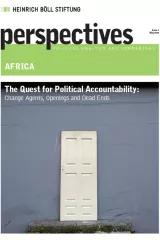
Since the third wave of democratisation swept through the continent in the 1990s, the majority of African states have replaced military dictatorships and one-party-dominant systems with more democratic forms of governance. Today, 61 percent of sub-Saharan countries are “free” or “partly free” according to Freedom House’s 2018 survey – although this is down from a high of 71 percent in 2008.
This edition of Perspectives seeks to explore how actors in the state, political parties, and civil society have been able to make those in government less certain about the future balance of power through and outside of the ballot box.
Which African leaders qualify as an icon? Perhaps this is always a controversial question, but it was much easier to answer, say, 25 years ago, when the public memories of Pan-Africanist champions such as Kwame Nkrumah and Julius Nyerere were still fresh, Nelson Mandela had just walked out of prison, and Robert Mugabe was a widely respected leader.
The “Big Bad Fix” provides a comprehensive overview of the key actors, technologies and fora relevant in the geoengineering discourse. It opposes geoengineering as a technofix for climate change and as a threat to world peace, democracy and human rights.
This edition of Perspectives contributes to the ongoing debate on infrastructure development in Africa by sharing snapshots of experience from around the continent, exploring questions about democratic participation, the role of human and environmental rights, and economic transformation.