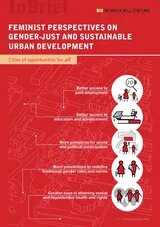
Urbanisation is a defining characteristic of life across the globe in the 21st century. Cities offer many opportunities for different types of people to forge a livelihood and lead a fulfilling social life. The diverse options are taken up in particular by women and people who renounce traditional, binary gender roles and norms and are thus often subject to various kinds of discrimination.
Throughout the history of social and political
movements in African societies, generations
of women have, in one way or another,
worked to oppose patriarchal domination,
laws and practices in the pursuit of gender
equality; advocating for their equal participation
in all aspects of social, economic and
political life. Despite this tradition of women-
centred and anti-patriarchal organising,
it is only in the last few decades, partly due
to efforts to entrench women’s emancipation
and gender equality in development
goals, that feminism in Africa has evolved as
an explicit ideological and political concept.
This study shows that port closures are governed not only by the law of the sea and human rights law, but also by WHO law and that non-refoulement obligations continue to apply even in emergency situations while a derogation is not permissible under international law.
Low-income countries (LICs) are suffering from triple distresses: the mortal impact of Covid-19, increasing debt burdens, and climate change impacts. This paper brings the debt-for-adaptation swap into play as an alternative source to restore countries' ability to act and be resilient to climate change.